You have probably heard the term "Artificial Intelligence" dozens of times this week alone. In the news, in job listings, in conversations at work.
-&-Why-is-it-Important_.jpg)
You have probably heard the term "Artificial Intelligence" dozens of times this week alone. In the news, in job listings, in conversations at work. But when someone asks you to explain it simply - what do you actually say?
This guide breaks down everything you need to know about AI in plain, easy-to-understand language. No jargon. No complicated tech speak. Just a clear picture of what AI is, how it works, why it matters, and how businesses like yours can start using it today.
And if you are ready to bring AI into your business right now, the team at Gree Web Solutions builds AI-powered solutions that are practical, results-driven, and tailored to your goals.
Artificial Intelligence, or AI, is a branch of computer science focused on building machines that can perform tasks that typically require human intelligence. Things like understanding language, recognizing images, making decisions, learning from experience, and solving complex problems.
In simple terms, AI is about teaching computers to think, learn, and act more like humans.
Artificial intelligence refers to computer systems that are capable of performing tasks traditionally associated with human intelligence - such as making predictions, identifying objects, interpreting speech, and generating natural language.
A good way to think about it: when you type a question into Google and get a smart, relevant answer - that is AI at work. When Netflix recommends a show you actually want to watch - that is AI. When your email filters out spam automatically - AI again.
AI is everywhere, and it is only getting more capable.
AI technology is the collection of tools, algorithms, software, and computing systems that make artificial intelligence possible. It is not one single thing - it is a whole family of technologies that work together.
AI encompasses many different disciplines, including computer science, data analytics and statistics, hardware and software engineering, linguistics, neuroscience, and even philosophy and psychology.
At the heart of all AI technology is one fundamental idea: learn from data, find patterns, and use those patterns to make better decisions.
AI systems learn and improve through exposure to vast amounts of data, identifying patterns and relationships that humans might miss. This data serves as the training material - the quality and quantity of which are crucial for the AI's performance.
The more data an AI system sees, the smarter and more accurate it becomes. This is why companies that collect a lot of data - like Google, Amazon, and Meta - have been at the forefront of AI development.
Here is a simple breakdown of how an AI system actually works:
Step 1 - Collect Data AI needs a lot of data to learn. This could be text, images, audio, numbers, or any other type of information relevant to the task.
Step 2 - Train the Model The data is fed into a mathematical model (called an algorithm). The model looks for patterns - for example, "when these features are present, this outcome tends to follow."
Step 3 - Test and Improve The model is tested on new data it has never seen before. Where it makes mistakes, it learns and adjusts. This process repeats many thousands of times.
Step 4 - Deploy Once the model performs well enough, it is deployed in a real application - a chatbot, a recommendation engine, a fraud detection system, and so on.
Step 5 - Keep Learning Good AI systems keep learning from new data after deployment, getting better over time without needing to be reprogrammed.
AI systems improve on their performance of specific tasks over time, allowing them to adapt to new inputs and make decisions without being explicitly programmed to do so. In essence, artificial intelligence is about teaching machines to think and learn like humans, to automate work and solve problems more efficiently.
AI is not one-size-fits-all. There are several key subfields, each designed to solve specific kinds of problems.
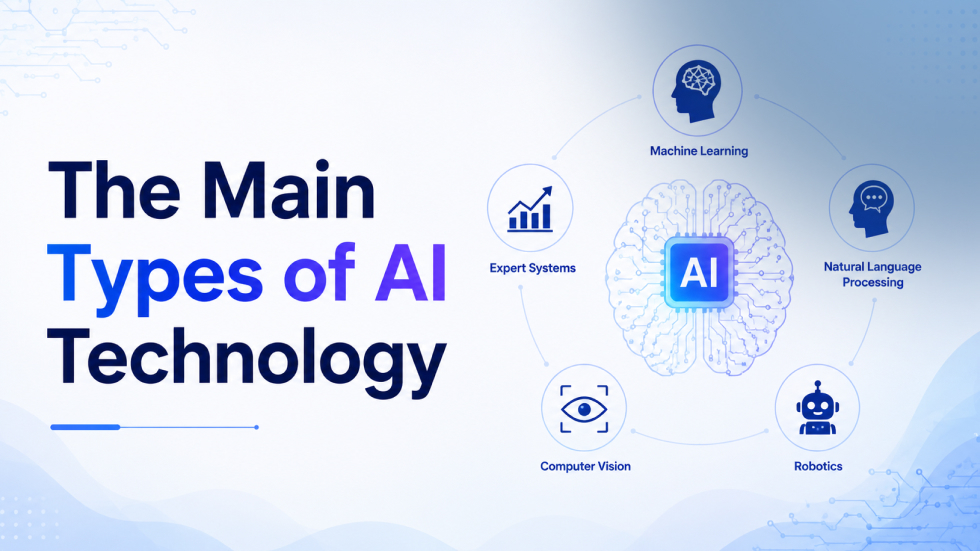
Machine learning is the primary approach to building AI systems, where computers learn from large data sets by identifying patterns and relationships within the data. A machine learning algorithm uses statistical techniques to help it learn how to get progressively better at a task, without necessarily having been programmed for that specific task.
Machine learning powers most of the AI applications you use daily - recommendation engines, search results, fraud detection, and more.
Deep learning is a subfield of machine learning that uses artificial neural networks with many layers to learn from data. These networks are inspired by the structure of the human brain and are particularly good at complex tasks like image and speech recognition.
Deep learning is what enables AI to recognize faces in photos, understand spoken words, and generate realistic images or text.
NLP enables computers to understand, interpret, and generate human language. This is what powers voice assistants like Siri and Alexa, translation services, and chatbots.
If you have ever asked Siri a question or used Google Translate, you have used NLP-powered AI technology.
Computer vision allows computers to "see" and interpret visual information from the world, such as images and videos. It is used in everything from facial recognition to self-driving cars.
Computer vision is also used in medical imaging, quality control in manufacturing, and retail checkout systems that do not require a cashier.
Sometimes the best way to understand AI is to see it in action. Here are some real, everyday examples of AI technology most people already use:
Google Search - Every time you search online, AI ranks results, understands your intent, and shows you the most relevant information.
Spotify & Netflix - These platforms use AI to study your listening and watching habits and recommend content you are likely to enjoy.
Email Spam Filters - AI scans incoming emails and automatically sorts spam into a separate folder so your inbox stays clean.
Face Unlock on Smartphones - Computer vision AI recognizes your face with incredible accuracy, even in different lighting conditions.
Chatbots & Customer Support - AI-powered chatbots answer customer questions 24/7, handle common queries instantly, and escalate complex issues to human agents.
Google Maps & Navigation - AI analyzes real-time traffic data, road conditions, and historical patterns to give you the fastest route.
Fraud Detection in Banking - Banks use AI to monitor millions of transactions per second and flag any that look suspicious.
Medical Diagnosis - AI systems can analyze medical scans and detect early signs of cancer or other conditions with a level of accuracy that rivals experienced doctors.
Each of these is a real-world example of AI technology making life easier, faster, and safer. And businesses across every industry are finding new use cases every day.
A common worry people have about AI is this: "Will AI replace humans?"
The reality is more nuanced. The best outcomes happen when humans and AI work together - not when one replaces the other. This is what is often called Human AI or Human-in-the-loop AI.
AI is able to interpret and sort data at scale, solve complicated problems, and automate various tasks simultaneously - which can save time and fill in operational gaps missed by humans.
AI handles the repetitive, data-heavy, and computationally intensive parts of a task. Humans handle the creative, empathetic, ethical, and relationship-based parts. Together, they achieve things that neither could alone.
A radiologist using AI to scan thousands of X-rays is more accurate and productive than one working without it. A marketing team using AI to generate and test dozens of ad variations will outperform a team that does everything manually. A software developer using AI coding assistants ships features faster than one who does not.
AI amplifies human capability. The businesses and professionals who learn to work with AI will have a significant advantage over those who do not.
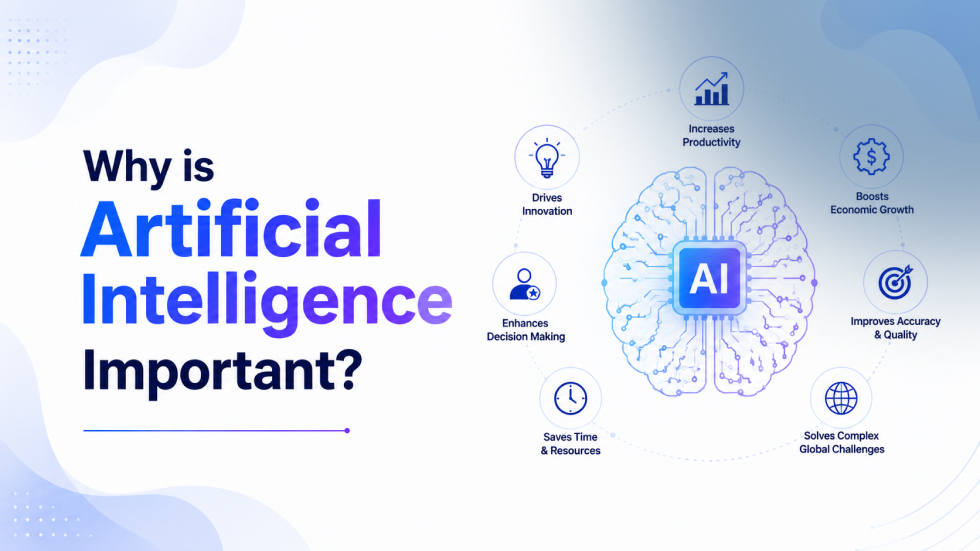
AI is not just a cool technology. It is becoming the foundation of how modern businesses operate and compete.
AI serves as the foundation for computer learning and is used in almost every industry - from healthcare and finance to manufacturing and education - helping to make data-driven decisions and carry out repetitive or computationally intensive tasks.
Here is why it matters so much right now:
Speed - AI can analyze millions of data points in seconds. What would take a human team weeks to process, an AI can do before your morning coffee is ready.
Accuracy - AI systems trained on good data make fewer mistakes than humans on repetitive, pattern-based tasks.
Scale - AI does not get tired or need lunch breaks. It can serve a thousand customers at the same time, all day, every day.
Cost Efficiency - Automating repetitive tasks with AI frees up your human team to focus on higher-value work - saving both time and money.
Competitive Advantage - Businesses using AI are moving faster, serving customers better, and making smarter decisions than their competitors.
Many existing technologies use artificial intelligence to enhance capabilities - in smartphones with AI assistants, e-commerce platforms with recommendation systems, and vehicles with autonomous driving abilities. AI also helps protect people by piloting fraud detection systems online and robots for dangerous jobs, as well as leading research in healthcare and climate initiatives.
AI is not limited to the tech world. It is reshaping industries across the board:
Healthcare - AI helps doctors detect diseases earlier, predict patient outcomes, and discover new drugs faster than ever before.
Finance & Banking - AI powers real-time fraud detection, credit scoring, algorithmic trading, and personalized financial advice.
Retail & E-commerce - AI drives product recommendations, demand forecasting, inventory management, and personalized marketing campaigns.
Manufacturing - AI systems monitor equipment for signs of failure, automate quality control, and optimize production schedules.
Education - AI personalizes learning paths, identifies struggling students early, and automates administrative tasks for teachers.
Logistics & Supply Chain - AI optimizes delivery routes, predicts delays, and manages warehouse operations with minimal human intervention.
No matter what industry you are in, AI is either already changing it or will be very soon.
Understanding AI is the first step. Implementing it in your business is where the real value happens - and that is where most companies need expert help.
Gree Web Solutions is a full-service enterprise IT and software development company that specializes in building practical, results-driven AI solutions. Their team works with businesses of all sizes to design, build, and deploy AI systems that actually solve real problems.
Here is how they can help you get started:
AI & Machine Learning Solutions - The core AI service. Their team builds custom machine learning models, integrates large language models (LLMs) into your products, creates intelligent chatbots, and develops AI-powered automation for your specific workflows. Whether you need a recommendation engine, a predictive analytics dashboard, or an AI content pipeline - they build it end to end.
Data Science & Analytics - AI is only as good as the data behind it. Their data science team helps you collect, clean, organize, and analyze your business data, turning raw numbers into actionable insights - and building the foundation that makes AI systems actually work.
Custom Software Development - Need a completely custom AI-powered application? They design and build tailored software that integrates AI capabilities directly into your business processes, your industry workflows, and your user experience.
Mobile Application Development - Want AI inside your mobile app? Think smart search, personalized content feeds, AI-powered customer support, or voice recognition features - all built natively into your iOS or Android application.
Web & CMS Platforms - Build a fast, SEO-optimized web platform that integrates AI features - smart content recommendations, intelligent search, chatbots, and dynamic personalization for every visitor.
Cloud Consulting - Running AI at scale requires robust cloud infrastructure. Their cloud architects design and manage the infrastructure your AI applications need to run fast, securely, and cost-efficiently as you grow.
Application Management & Modernization - Already have existing software? Their team upgrades legacy systems with AI capabilities so you do not have to rebuild from scratch.
No matter where you are on your AI journey - just exploring, planning your first project, or ready to scale - Gree Web Solutions has the team and expertise to take you there.
Talk to an AI expert at Gree Web Solutions today →
Artificial Intelligence is no longer a futuristic concept. It is here, it is real, and it is changing the way every industry operates - right now.
The businesses that understand AI, invest in it, and integrate it thoughtfully into their operations will outpace those that are slow to adapt. The good news is that you do not have to figure it all out on your own.
Gree Web Solutions brings together deep expertise in AI & Machine Learning, Data Science, Custom Software Development, Mobile Apps, and Cloud Infrastructure - everything you need to build real AI solutions that deliver real business results.
Whether you are taking your very first step into AI or ready to scale an existing system, their team is ready to help.
Start your AI journey with Gree Web Solutions →
Artificial intelligence is technology that allows computers to do things that normally require human thinking - like understanding language, recognizing images, solving problems, and learning from experience. It is not magic or science fiction. It is a set of mathematical algorithms trained on large amounts of data so that machines can make smart decisions on their own. You experience AI every time you use a search engine, get a Netflix recommendation, or speak to a voice assistant.
AI is already deeply embedded in daily life. Common examples include Google Search (AI ranks and understands your queries), email spam filters (AI detects and blocks unwanted messages), Face ID on your phone (computer vision recognizes your face), product recommendations on Amazon or Netflix (AI studies your behavior to suggest what you might like), navigation apps like Google Maps (AI analyses real-time traffic to find the fastest route), and customer support chatbots (AI answers your questions 24/7 without a human agent).
These three terms are related but not the same. AI is the broad concept - building machines that can perform intelligent tasks. Machine Learning is a method within AI where computers learn from data instead of being manually programmed with rules. Deep Learning is a specific type of machine learning that uses multi-layered neural networks inspired by the human brain - and it is the technology behind the most impressive AI breakthroughs of recent years, like image recognition and large language models (LLMs) such as ChatGPT.
AI - like any powerful technology - comes with both opportunities and risks. Used responsibly, AI creates enormous value: it makes businesses more efficient, improves customer experiences, and helps solve complex problems. The risks to be aware of include biased outputs (when AI is trained on biased data), privacy concerns (when AI systems collect sensitive information without proper safeguards), and over-reliance without human oversight. The key is to implement AI thoughtfully - with proper governance, quality data, and human review built in. Working with an experienced partner like Gree Web Solutions ensures your AI systems are built responsibly and securely from day one.
You do not need to be a large corporation to benefit from AI. Small and mid-size businesses can start with high-impact, low-complexity use cases - like deploying an AI chatbot for customer support, using AI tools to generate or improve marketing content, automating repetitive data entry or reporting tasks, or adding personalized product recommendations to an e-commerce store. The best approach is to identify one area where your team spends a lot of time on repetitive work and explore whether AI can handle it. If you want expert guidance tailored to your business and industry, book a free consultation with Gree Web Solutions →
Connect with us for any inquiries, support, or collaboration opportunities.